
Where the Energy Really Goes: What Measuring Five Digital Farming Pilots Revealed
Digital tools promise to make farming more sustainable, but they also consume energy themselves. Servers, routers, sensors and onboard computers all draw power. So how big is the digital footprint compared with the savings it brings?
OpenAgri set out to measure this properly. In each of our five Sustainable Innovation Pilots, we tracked not only computing and network energy, but the energy of the whole farming operation: tractors, drones, pumps and trips to the field. The results changed how we think about sustainable digital agriculture.
The computer is rarely the main consumer
Across the pilots, a clear pattern emerged: the machinery doing the work uses far more energy than the computers guiding it.
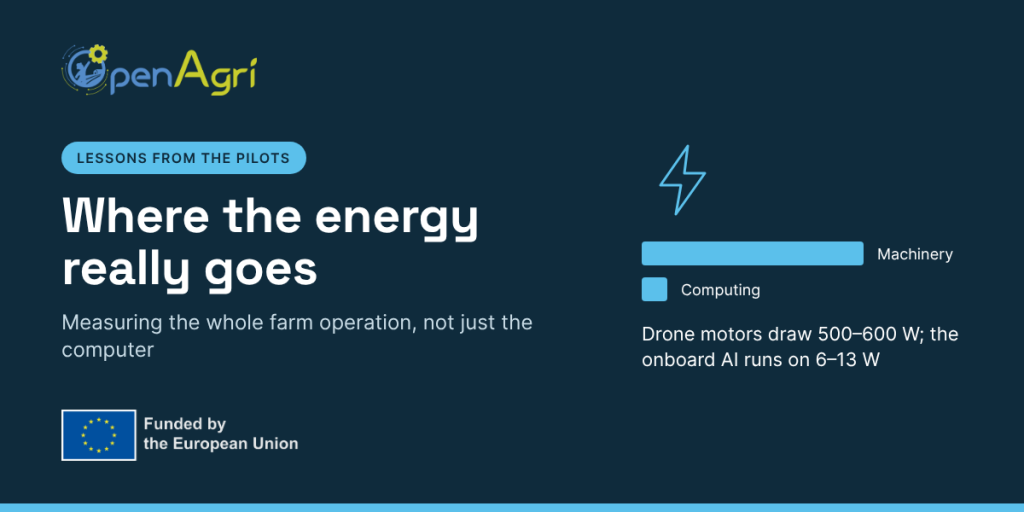
• Drones in Belgium (SIP3). The onboard computer used 6 to 13 W during pest detection. The drone’s propellers drew 500 to 600 W, and a typical 10-minute mission used 90 to 100 Wh whichever mode ran the AI.
• Irrigation in Poland (SIP4). The irrigation pump used about 553 kWh over the season. The smart controller’s computing added 55 to 87 kWh, depending on the mode.
• Tractors in Greece (SIP1). Mounting the AI scouting system on the tractor made no difference to fuel use, which stayed at 2.8 L/km.
The real gains come from changing the operation
If the computer is a small part of the energy picture, where do the savings come from? The answer is that digital tools change what happens in the field.
• Fewer trips. In France (SIP2), remote monitoring of the herd’s water trough let farmers visit every three days instead of every two, saving 44 litres of diesel per grazing season. In Cyprus (SIP5), compost producers needed 14 field visits instead of 35.
• Less water and fewer inputs. In Greece, targeted spraying in Edge mode used 40% less water than blanket spraying. In Belgium, prescription maps let farmers treat only the zones where the beetle was found.
• Smarter timing. In Poland, weather-aware irrigation cut planned doses on three occasions when heavy rain was forecast, part of a 40% saving in water. Less water pumped means less energy used by the biggest consumer on the farm.
Sometimes using more digital energy saves more overall
The French livestock pilot offers a telling example. Cloud mode needs a 4G router running around the clock, which raised daily energy use from 156 Wh to 276 Wh. Edge mode is more frugal, but the farmer still has to drive to the pasture to collect the data. Cloud mode used more electricity and still came out ahead, because it removed a third of the field visits and the diesel that went with them.
Poland shows the same logic. Cloud mode used more computing energy than Edge mode, but it was the only mode that could use weather forecasts, and those forecasts delivered both the higher yield and the bigger water saving.
Computing efficiency still matters, in the right places
None of this means computing energy is irrelevant. For devices that run on batteries or solar power in remote fields, every watt counts. That is where Edge mode shines: in Greece, it used 88% less power in the field than Cloud mode, and in Belgium a Raspberry Pi handled pest detection on just a few watts. Low-power design is what makes it possible to run AI where there is no grid and no signal.
Measure the whole system
The main lesson from Year 1 is simple: judge digital farming tools by the whole operation, not just the device. A tool that uses a little more electricity but saves trips, water or pesticide can be the more sustainable choice. A tool that is extremely efficient but changes nothing in the field is not.
This is why every OpenAgri pilot reports on computing, network and energy use alongside agricultural performance. It gives farmers, advisors and policymakers the full picture, and helps the sector invest in the changes that make the biggest difference.