
SIP1 Year 1 Results: AI Scouting Caught Every Disease Case in Greek Vineyards
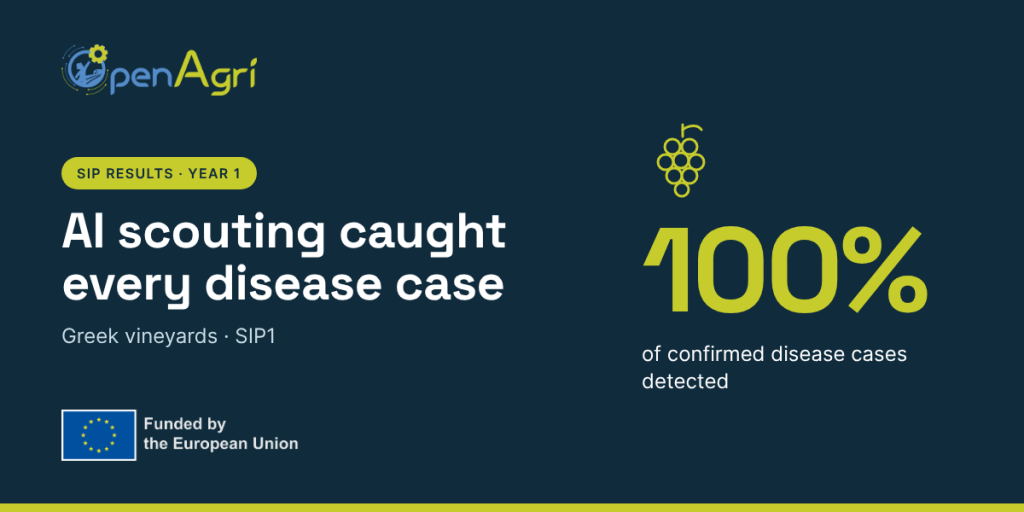
Sustainable Innovation Pilot 1 (SIP1), led by Eden Library in Greece, is replacing slow, inconsistent manual scouting in vineyards with continuous data from the vine itself. Its Year 1 results, covering a full season in the field, are now in.
The challenge: finding disease before it spreads
In Greek vineyards, scouting is still largely done by eye. It is labour-intensive, and disease is often found days or weeks after it has taken hold. Spraying usually follows a fixed calendar for the whole vineyard, regardless of where the problem actually is. The result is unnecessary pesticide use, higher costs and missed yield potential.
SIP1 answers this with the Viewer, a camera and computing unit mounted on a tractor that is already driving through the rows. As it passes, AI detection models identify disease, assess canopy density and vine vigour, and count visible grape clusters. Every detection is tied to GPS coordinates, producing digital maps that vineyard managers use to generate targeted spray prescriptions.
The system was tested in two deployment modes. Cloud mode records full video and uploads it via Wi-Fi for remote processing. Edge mode processes video in real time on the tractor and sends only lightweight results over 3G.
What farmers told us
Seven farmers and one advisor, working with the Tselepos and Kyr-Yianni wineries, tested the Viewer through the season. Their feedback shaped how we read every number that follows.
• Cloud mode was seen as easy to use. It needs only moderate digital skills, fits existing farm machinery, and was strongly endorsed for wider adoption.
• Data privacy matters. Farmers were concerned about farm data leaving the farm. Edge mode, which keeps data on-site, was preferred on this point.
• A phased approach is the way forward. Participants recommended starting with Cloud mode to collect data and improve the detection models, then moving to Edge mode for lower energy use and sustained on-farm operation.
In their words, the strategy is: start with Cloud, transition to Edge.
Year 1 in numbers
• 100% of confirmed disease cases detected. Both modes caught every real case, with zero missed. Edge mode produced fewer false alarms: 7 false positives compared with 16 in Cloud mode.
• 40% less water with targeted spraying in Edge mode, compared with blanket application across all rows. Targeted spraying also means less pesticide and less runoff.
• Up to 82% faster first detection in Cloud mode, at 11 to 17 seconds compared with 19 to 95 seconds for Edge. After that, both modes process video continuously at 10 frames per second.
• 700 times less data transmitted in Edge mode: 1.74 MB over 3G per session, compared with 1.26 GB over Wi-Fi for Cloud.
• 88% less power in the field in Edge mode: 57 W compared with 474 W.
• No extra fuel. Tractor fuel use stayed at 2.8 L/km in both modes, so adding AI scouting adds no mechanical overhead.
What still needs work
Year 1 was also about finding the limits. Yield estimation works but is not yet precise: Cloud mode under-counted grape clusters by 10% (472 counted against 527 actual), while Edge mode over-counted by 46%.
Canopy measurements were closer to ground truth in Cloud mode (46.9% against 51.9%) than in Edge mode (38.7%). Calibrating yield and canopy estimates is a priority for Year 2, along with prescription maps for Cloud mode.
Built on OpenAgri OS-based services
SIP1 integrates three OpenAgri OS-based services: the Weather Data Service, the Digital Farm Calendar and the Reporting Service. Both modes export results in open formats, including GeoJSON maps for disease, yield, vigour and spraying that load directly into farm management tools. The Viewer itself mounts with suction cups, magnets or a roll-bar plate, so it works on any tractor without permanent modification.
SIP1 shows that AI scouting can run on equipment farmers already use, catch disease reliably, and cut inputs at the same time. Year 2 will focus on making its estimates as dependable as its detections.