
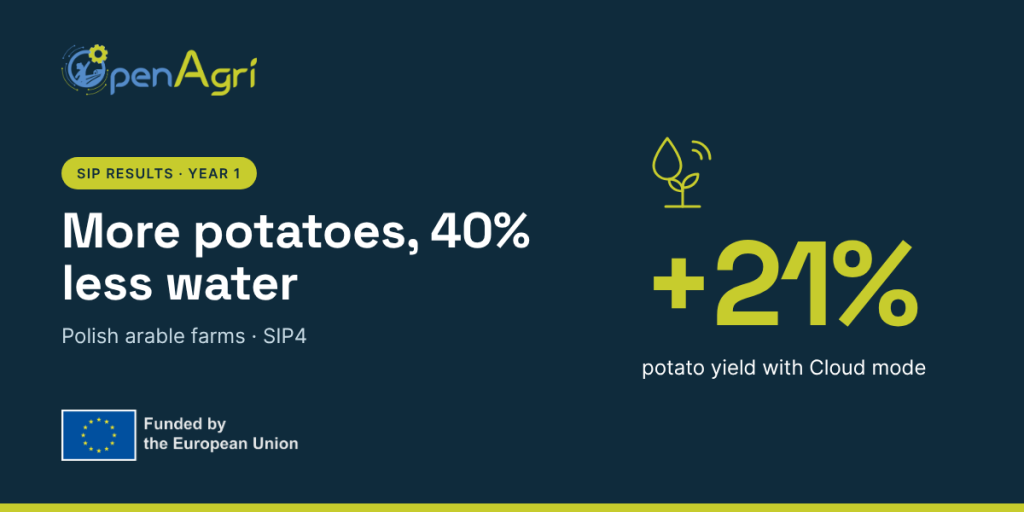
SIP4 Year 1 Results: 21% More Potatoes With 40% Less Water
Water stress and rising energy costs are squeezing Polish arable farmers, especially those growing water-hungry crops like potatoes and sugar beet. Sustainable Innovation Pilot 4 (SIP4), led by PSNC (Poznan Supercomputing and Networking Center) with L-PIT and DIH WODR, tested whether an open-source smart controller could water more precisely than a fixed schedule. After its first season, the answer is a clear yes.
The challenge: irrigating by the calendar
Without real-time data on soil and weather, most irrigation follows a fixed schedule. Fields get watered whether they need it or not, sometimes just before heavy rain. That wastes water, raises pumping costs and leaves yield on the table.
SIP4 replaces the calendar with data. Soil moisture sensors send readings across the field over LoRaWAN. The controller combines them with weather forecasts and evapotranspiration models to work out how much water the crop needs, and when. It then opens valves and runs the pump automatically. If heavy rain is forecast, it scales back or cancels the next irrigation. Farmers can follow and override every decision from a mobile dashboard.
Two deployment modes were tested. Cloud mode connects the sensors to a remote platform that adds weather forecasts to every decision. Edge mode runs everything on a local mini-PC with no internet, using soil readings alone.
What farmers told us
SIP4 is the one pilot where farmers leaned towards Cloud mode, and the reasons are instructive.
• Strong support for wider adoption, led by Cloud. Satisfaction was consistent across both modes, but farmers most strongly backed broader rollout of Cloud mode, which met little organisational resistance.
• Cloud needs training. It requires higher digital skills, so scaling it will need support. Farmers also saw it as a way to bring advanced, data-driven tools to their communities and narrow the digital divide.
• Edge is a future direction. As soil and weather data build up over seasons, local models can improve, giving Edge mode more autonomy over time.
The pilot in one line: more yield, less water, and the data does the deciding.
Year 1 in numbers
• 21% higher yield in Cloud mode, reaching 48.4 t/ha. Edge mode delivered 42.5 t/ha, a 6% gain over conventional irrigation.
• 40% less water in Cloud mode and 20% less in Edge mode, compared with conventional irrigation.
• Rain-aware watering. On three occasions, Cloud mode cut a planned dose from 25 mm to 15 mm because heavy rain was forecast. This is the decisive difference between the two modes: Edge mode cannot see the forecast.
• 84% less manual work in Cloud mode and 67% in Edge mode, by removing daily field measurements, soil sampling and manual scheduling.
• 36.5% less computing energy in Edge mode over the season (about 55 kWh against 86.7 kWh), at the cost of no forecast data.
Where the real savings are
The pump used about 553 kWh over the season in both modes. Computing and data transmission are small by comparison. The biggest energy gains therefore come from smarter scheduling, which is exactly what weather-aware Cloud mode delivers.
Built on open standards and OpenAgri OS-based services
SIP4 integrates the OpenAgri OS-based Weather Data Service for forecasts and historical climate data, and the Irrigation Service for soil moisture analysis and irrigation scheduling. Data follows the OpenAgri Common Semantic Model (OCSM) and was validated against the Digital Farm Calendar.
The controller is fully open: it runs in Docker containers, exposes a REST API, and works with LoRaWAN sensors and actuators from multiple manufacturers. An IRRTEC bridge sprinkler was integrated during the pilot, and the system runs on Raspberry Pi hardware.
SIP4 shows that adding the weather forecast to irrigation decisions pays off quickly, in yield, water and time. Year 2 will test how far local models can close the gap for farms without a reliable connection.