
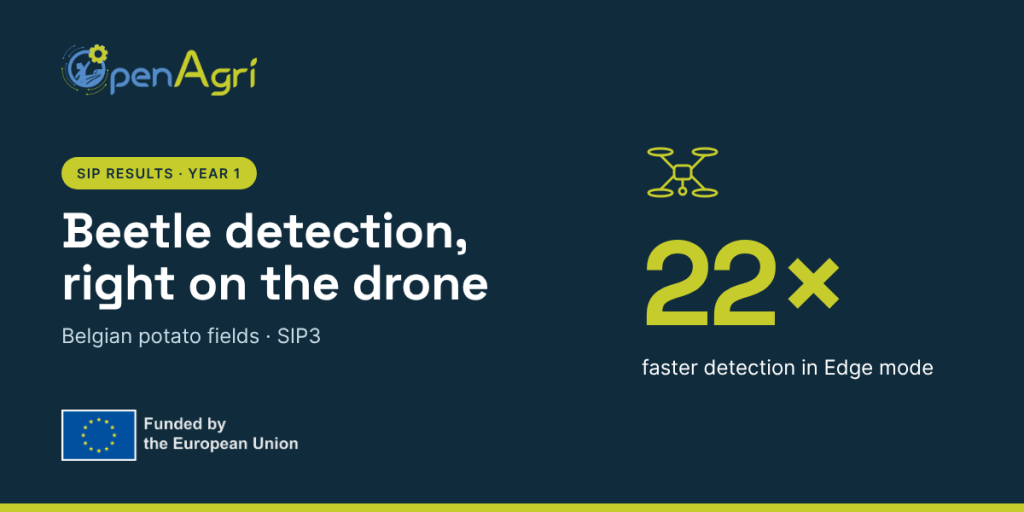
SIP3 Year 1 Results: Edge Drone Scouting Detects Potato Beetle 22x Faster
Belgian potato farmers routinely spray against the Colorado Potato Beetle twice a season, whether the beetle is there or not. Sustainable Innovation Pilot 3 (SIP3), led by EV ILVO with farmer partner ISP, set out to change that with autonomous drones and AI detection. After a full season of testing, the Year 1 results are in.
The challenge: blanket spraying against a resilient pest
The Colorado Potato Beetle reproduces quickly and feeds heavily on potato foliage. Routine blanket spraying keeps it in check, but it raises costs, speeds up pesticide resistance and risks contaminating ground and surface water.
SIP3 replaces routine with precision. An autonomous drone flies a pre-planned route over the field and captures high-resolution images of the crop. An AI model identifies adult beetles and larvae at different growth stages and maps exactly where they are. Those infestation maps become prescription maps, so pesticide goes only to the zones where the pest is confirmed.
Two deployment modes were tested. In Cloud mode, images are uploaded to a remote server for analysis. In Edge mode, detection runs on the drone itself during the flight, using an onboard AI accelerator, and only compact results are sent.
What farmers told us
• Both modes fit existing routines. Edge mode was rated very easy to use with no adoption resistance, and Cloud mode also met expectations. Farmers saw both as tools that support their agronomic practice rather than replace it.
• Connectivity shapes the choice. Cloud mode depends on a stable, high-bandwidth connection, which is a real limitation in rural Belgian fields. Edge mode removes that dependency.
• Edge was strongly preferred. It keeps data on the farm, uses less bandwidth and energy, works reliably, and was seen as helping to close the digital divide.
The pilot’s idea in one line: detect only where needed, spray only where needed.
Year 1 in numbers
• 22 times faster detection in Edge mode. A full detection cycle takes 1.2 seconds on the drone, compared with about 27 seconds in the cloud. Over 3G or 4G, uploading full-resolution images for Cloud mode can add minutes more.
• Practically equal accuracy. Cloud mode scored a mAP50 of 0.701 and Edge mode 0.687. The beetle is visually distinct enough that a lightweight onboard model detects it reliably.
• 26% lower cost per mission in Edge mode: about 94 EUR compared with 127 EUR, mainly because large image uploads and cloud computing are no longer needed. One avoided spray application can pay for several monitoring flights.
• Low computing power at the edge. The onboard Raspberry Pi 5 draws 6 to 13 W during detection, while the cloud server sustains 35 to 37 W.
A finding that reaches beyond software
Measuring energy end to end produced an important insight. The drone’s propellers draw 500 to 600 W in flight, and a typical 10-minute mission uses 90 to 100 Wh in either mode. Computing is a small share of that. For sustainability, optimising flight paths matters more than optimising the AI.
Built on open standards and OpenAgri OS-based services
SIP3 integrates three OpenAgri OS-based services: the Weather Data Service for infestation risk prediction, the Pest & Disease Management Service for logging and mapping outbreaks, and the Digital Farm Calendar for recording scouting sessions over time.
The system is built to avoid lock-in. It accepts JPEG images from any drone or camera, runs on a Raspberry Pi, Jetson or similar board, and exports prescription maps in ISOXML, shapefile or GeoTIFF, formats that precision sprayers can use directly. Every component in its modular pipeline can be swapped without rewriting the rest.
SIP3 shows that precision pest control does not need a fast connection or expensive computing. It needs good detection in the right place, and Edge mode puts it right on the drone.